Global corporate tax competition challenges climate change mitigation
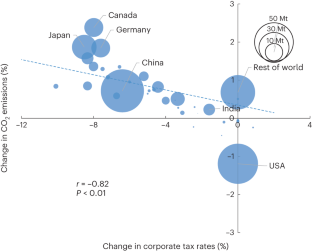
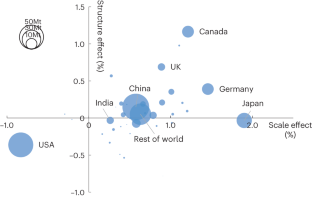
Many countries have cut their corporate tax rates in the past decades to attract foreign investment. To prevent this, a global minimum tax policy was approved by OECD countries in 2021. Global changes in corporate tax rates could reshape production and investment networks while impacting welfare and global emission patterns. Here we develop a theoretical multi-country multi-industry general equilibrium model and show that global corporate tax competition during 2005–2016 would increase global carbon emissions and shift more emissions to developing economies. Implementing a global minimum tax rate of 15% would reduce global carbon emissions and effectively decrease the developing economies’ emissions. The results highlight that corporate tax policies should be coordinated with climate regulations.
This is a preview of subscription content, access via your institution
Access options
Access Nature and 54 other Nature Portfolio journals
Get Nature+, our best-value online-access subscription
cancel any time
Subscribe to this journal
Receive 12 print issues and online access
206,07 € per year
only 17,17 € per issue
Buy this article
- Purchase on SpringerLink
- Instant access to full article PDF
Prices may be subject to local taxes which are calculated during checkout
Inequality repercussions of financing negative emissions
Article 30 November 2023
Embodied carbon emissions in the supply chains of multinational enterprises
Article 07 September 2020
Regional trade agreement burdens global carbon emissions mitigation
Article Open access 20 January 2022
References
- Madiès, T., Tarola, O. & Taugourdeau, E. Tax haven, pollution haven or both? Int. Tax Public Finance29, 1527–1560 (2022). ArticleGoogle Scholar
- Iovino, L., Martin, T. & Sauvagnat, J. Corporate taxation and carbon emissions. SSRNhttps://doi.org/10.2139/ssrn.3880057 (2021).
- Abe, K. & Zhao, L. Endogenous international joint ventures and the environment. J. Int. Econ.67, 221–240 (2005). ArticleGoogle Scholar
- Copeland, B. R. & Taylor, S. M. Trade and the Environment. Theory and Evidence (Princeton Univ. Press, 2003).
- Cai, X., Lu, Y., Wu, M. & Yu, L. Does environmental regulation drive away inbound foreign direct investment? Evidence from a quasi-natural experiment in China. J. Dev. Econ123, 73–85 (2016). ArticleGoogle Scholar
- Hanna, R. US environmental regulation and FDI: evidence from a panel of US-based multinational firms. Am. Econ. J. Appl. Econ.2, 158–189 (2010). ArticleGoogle Scholar
- Dean, J. M., Lovely, M. E. & Wang, H. Are foreign investors attracted to weak environmental regulations? Evaluating the evidence from China. J. Dev. Econ.90, 1–13 (2009). ArticleGoogle Scholar
- Chung, S. Environmental regulation and foreign direct investment: evidence from South Korea. J. Dev. Econ.108, 222–236 (2014). ArticleGoogle Scholar
- Bruca, A., Javorcik, B. & Love, I. Good for the environment, good for business: foreign acquisitions and energy intensity. J. Int. Econ.21, 103247 (2019). ArticleGoogle Scholar
- Eskeland, G. S. & Harrison, A. E. Moving to greener pastures? Multinationals and the pollution haven hypothesis. J. Dev. Econ.70, 1–23 (2003). ArticleGoogle Scholar
- Ramondo, N. & Rodríguez-Clare, A. Trade, multinational production, and the gains from openness. J. Polit. Econ.121, 273–322 (2013). ArticleGoogle Scholar
- Arkolakis, C., Ramondo, N., Rodriguez-Clare, A. & Yeaple, S. Innovation and production in the global economy. Am. Econ. Rev.108, 2128–2173 (2018). ArticleGoogle Scholar
- Alviarez, V. Multinational production and comparative advantage. J. Int. Econ.119, 1–54 (2019). ArticleGoogle Scholar
- Wang, Z. Multinational production and corporate taxes: a quantitative assessment. J. Int. Econ.126, 103353 (2020). ArticleGoogle Scholar
- Tintelnot, F. Global production with export platforms. Q. J. Econ.132, 157–209 (2017). ArticleGoogle Scholar
- Elliott, J. et al. Trade and carbon taxes. Am. Econ. Rev.100, 465–469 (2010). ArticleGoogle Scholar
- Copeland, B. R., Shapiro, J. S. & Taylor, M. S. in Handbook of International Economics Vol. 5 (eds Gopinath, G. et al.) 61–146 (Elsevier, 2022).
- Larch, M. & Wanner, J. Carbon tariffs: an analysis of the trade, welfare, and emission effects. J. Int. Econ.109, 195–213 (2017). ArticleGoogle Scholar
- Shapiro, J. S. & Walker, R. Why is pollution from U.S. manufacturing declining? The roles of environmental regulation, productivity, and trade. Am. Econ. Rev.108, 3814–3854 (2018). ArticleGoogle Scholar
- Farrokhi, F. & Lashkaripour, A. Can Trade Policy Mitigate Climate Change? STEG Working Paper (STEG, 2022).
- Duan, Y., Ji, T., Lu, Y. & Wang, S. Environmental regulations and international trade: a quantitative economic analysis of world pollution emissions. J. Public. Econ.203, 104521 (2022). ArticleGoogle Scholar
- Shapiro, J. S. Trade costs, CO2, and the environment. Am. Econ. J. Econ. Policy8, 220–254 (2016). ArticleGoogle Scholar
- Bierbrauer, F., Brett, C. & Weymark, J. A. Strategic nonlinear income tax competition with perfect labor mobility. Games Econ. Behav.82, 292–311 (2013). ArticleGoogle Scholar
- Liu, Z. Foreign direct investment and technology spillovers: theory and evidence. J. Dev. Econ.85, 176–193 (2008). ArticleGoogle Scholar
- Demena, B. A. & van Bergeijk, P. A. A meta-analysis of FDI and productivity spillovers in developing countries. J. Econ. Surv.31, 546–571 (2017). ArticleGoogle Scholar
- Peters, G. P. & Hertwich, E. G. CO2 embodied in international trade with implications for global climate policy. Environ. Sci. Technol.42, 1401–1407 (2008). ArticleCASGoogle Scholar
- Tian, K., Zhang, Y., Li, Y., Ming, X. & Wang, S. Regional trade agreement burdens global carbon emissions mitigation. Nat. Commun.https://doi.org/10.1038/s41467-022-28004-5 (2022).
- Cadestin, C. et al. Multinational Enterprises and Global Value Chains: The OECD Analytical AMNE Database (OECD Publishing, 2018).
- Zhang, Z., Guan, D., Wang, R., Meng, J. & Du, H. Embodied carbon emissions in the supply chains of multinational enterprises. Nat. Clim. Changehttps://doi.org/10.1038/s41558-020-0895-9 (2020). ArticleGoogle Scholar
- Interagency Working Group on Social Cost of Greenhouse Gases. Technical Support Document: Technical Update of the Social Cost of Carbon for Regulatory Impact Analysis Under Executive Order 12866 (United States Government, 2016).
- Copeland, B. R. & Taylor, M. S. International Trade and the Environment: A Framework for Analysis. Working Paper Series 8540 (National Bureau of Economic Research, 2001).
Acknowledgements
We gratefully acknowledge the financial support from the National Natural Science Foundation of China (No. 72394404 to Z.Z.), the National Social Science Foundation of China (No. 22CJY019 to Y.D.), the National Natural Science Foundation of China (No. 71988101 to W.S., No. 72261147471 to Y.D., Nos. 71834004 and 71974141 to Z.Z.), the major program of the National Social Science Fund of China (No. 22&ZD086 to Y.D., No. 19ZDA062 to Y.C., No. 20&ZD079 to Y.L.). Special thanks to Longfei Cai and Yuan Gao from Central University of Finance and Economics in China for the excellent research assistant work.
Author information
Authors and Affiliations
- School of International Trade and Economics, Central University of Finance and Economics, Beijing, China Yuwan Duan
- State Key Laboratory of Marine Environmental Science, College of the Environment and Ecology, Xiamen University, Xiamen, Fujian, China Zengkai Zhang
- Questrom School of Business, Boston University, Boston, MA, USA Yuze Li
- Academy of Mathematics and Systems Science, Chinese Academy of Sciences, Beijing, China Shouyang Wang & Cuihong Yang
- School of Economics and Management, University of Chinese Academy of Sciences, Beijing, China Shouyang Wang & Cuihong Yang
- School of Entrepreneurship and Management, ShanghaiTech University, Shanghai, China Shouyang Wang
- School of Economics and Management, Tsinghua University, Beijing, China Yi Lu
- Yuwan Duan
